
- Homepage
- Age
- Brand
- Maker
- Movie
- Set Includes
- Tv Show
- G.i. Joe (9)
- Gi Joe (16)
- He Man (2)
- Karate Kid (2)
- M.a.s.k. (4)
- Mask (2)
- My Little Pony (3)
- Pee-wee's Playhouse (3)
- Power Rangers (5)
- Star Wars (24)
- Star Wars Rebels (3)
- Star Wars: Ewoks (2)
- Street Sharks (5)
- The Mandalorian (5)
- The Smurfs (2)
- Toy Story (2)
- Transformers (29)
- Voltron (3)
- Willow (2)
- Wwf Superstars (3)
- ... (5923)
Vintage Palech Porcelain Trinket box, Russian Art of stunning detail / Pristine
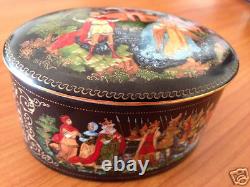
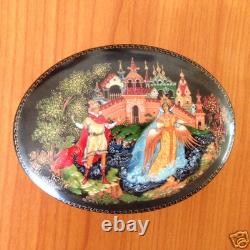
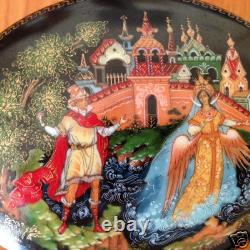
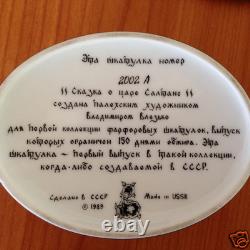
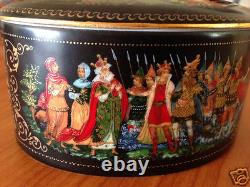
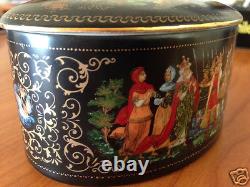
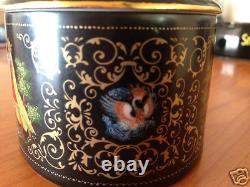
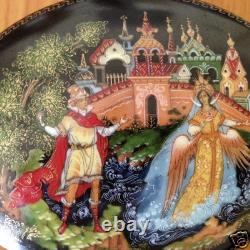


The "Tsar Saltan" fairy tale Art Box Continuing 600- year tradition of lacquer art, Palech Master Artist Vladimir Vlezko painted the original using hand ground colors and fine, sable hair brushes. After lavishly applying 22K gold highlights, he polished the entire artwork with a wolf's tooth and dusted it with a duck's wing. Now it is re-created in porcelain in a limited re-production.
This is # 2000A of 2000 first and the only production of 1989. Size: Oval - 4-1/4" W x 2-3/8" H Palech History and background information: Peaceful PALEKH - The Beginnings of Palekh Art: The Icon Painting Workshops.
The first settlement of thickly forested and thus secluded and remote Palekh dates back to the 14th century, when monks fleeing the Mongol invaders set up a small community. In seventeenth century rural Russia the Palekh peasants were serfs on the estate of the Buturlin clan, which owned the land from 1628 to 1861.
In those days, icons , which depict in graphic form the people, events, and moral stories of the Bible. We re an important teaching tool for the illiterate population, and therefore much in demand.
In the village of Palekh, a few artistically gifted individuals were encouraged to try their hand at icon-painting, which meant copying the traditional Byzantine-style images. Very soon a cottage industry sprang up with different people assigned to do separate tasks.These stages of icon production included preparing the wooden panels, priming them, mixing the egg and vinegar based tempera pigments and painting only a specific portion of the image according to the painterÂ's specialty and skill (backgrounds, drapery, foliage, hands and faces on any one icon were executed by different individuals), decorating the completed image with gilding and highlighting, making the proper religious inscriptions, and finally, applying drying oil to the finished product. PALEKH The Firebird : Rising from the Ashes of Bolshevik Devastation. The October 1917 Revolution dealt a heavy blow to icon painting in Palekh and throughout Russia. Not only the holy images themselves but the artists who made them became enemies in the eyes of the new Communist regime and were persecuted, arrested, exiled or even murdered.
As the Bolsheviks suppressed any form of religious expression, most former icon-painters resorted to supporting themselves with braiding bast shoes, farming or other domestic trades, while others left to seek work elsewhere. Those who continued with painting met with little success since they lacked experience in all areas other than the rigid process of copying icons. Once-great iconographers were now found decorating wooden tableware, chests, salt cellars, matryoshka dolls, and even porcelain and glass dishes, but without much distinction. Subsequently, the PaintersÂ' and CraftsmenÂ's Cooperatives that were established immediately following the Revolution all went bankrupt and were dissolved.In the early1920s, during the expansion of the Soviets' New Economic Policy, former icon painter Ivan Golikov visited his relatives in far away Moscow. There he saw and was fascinated by the already famous LUKUTIN painted lacquer wares. On display in the Museum of Decorative Arts.
None of these city officials believed in the artistic capability of the former icon-painter from the rural province, and flatly refused. He then painted on them two original compositions from his free flowing imagination: "A Plowman" and "Adam in Paradise" (which was inspired by Gustave DoreÂ's illustration of the bible). These prototypes exceeded everyoneÂ's expectations.